Showing posts with label plant of the week. Show all posts
Thursday, August 12, 2010
Plant of the Week: California Fuchsia
Folks in other parts of the country may not believe me, but I'm typing with cold hands, wearing a scarf at the moment. The hood on my hoodie is firmly planted over my head and I'm giving dirty looks to the thermostat, which calmly continues to tell me it's 66 degrees in the house. What happened to August?! It's a good thing the Zauschnerias are adding some heat with their spicy blooms as they head into their prime season.
Technically, some would call these Epilobiums, but honestly I think everyone still calls them Zauschnerias since it's a way more fun word to say. Either way, this gray to green-foliaged plant can be range from sub-shrub to groundcover, from shocking red-orange to white displays of flowers and blooms exactly when us native folks have given up coaxing the Buckwheats to continue blooming for just one week longer. The bright color contrasts so well against neutral grasses, too such as Blue Fescues, Deer Grasses, or even the dried stalks of Purple Needle Grass.
Not sure which variety this one goes by, but it's a groundcover with green leaves, blooming voraciously for the last month with no end in sight. Note the fuzzy seedheads in the top corner of the photo- cool! Thanks, neighbor Frank for letting me borrow one of your supermodels.
Mine, however I believe are 'Catalina', a taller variety with silver leaves and red-purple stems. The Eriogonum 'St. Catherine's Lace' is stealing the show at the moment, but hopefully as the blossoms begin to open on the Fuchsia, the flowers of the Eriogonum will create a contrasting backdrop. They've had less time in the ground than Frank's lovely specimen, but I've already noticed how interested these are in heading towards the sky. After blooming, I think I'll prune the tallest stems back to help maintain a bushy shape. I selected it for the foliage and that's the part that's year round. Yippee!
Wait, did I mention that these give hummingbirds the vapors? Yeah, turns out they do.
Sun: Full sun to part shade (hint: the gray or fuzzy-foliaged ones will take more sun than the green-leaved varieties for the most part)
Soil: Something between total sand and thick clay. It's pretty adaptable.
Plant: Ideally in the Spring or Fall, but I realize it's one of those plants you see in the nursery and never noticed before until it started blooming. Go for it, especially since we have had no scorching days to speak of this season anyway.
Buy it: Your local nursery should be tuned into this fella- ask them to recommend a cool variety for you, like 'Sierra Salmon' which has salmon-colored flowers. Just remember that some folks call this Epilobium and that might cause confusion.
Good for: gray gardens, hummingbird wars, late season color, a festive shot of contrast, sidewalk strips
Wednesday, July 21, 2010
Plant of the Week: Britton's Liveforever
When the annuals start looking crispy, Dudleya brittonii stays cool as a cucumber. A sweet rosette of gray-white leaves, this succulent glows radiantly when paired with grasses and small-leaved natives. From Baja, she's sort of pushing the boundary of CA native, so not on the wishlist of the purists out there. Pink tinged stems rise Winter to Spring, bringing little yellow flowers with them.
Sun: Part shade or morning sun is ideal.
Soil: very well drained, containers with lots of lava rock are recommended if you're worried about garden soil conditions
Plant: Anytime
But it: Cactus Jungle! Great nursery with bonus whippets. I also wonder if the Dry Garden carries them...
Good for: rock gardens, succulent gardens, white & gray gardens, contemporary gardens, planting into rock walls, adding alternative textures
Friday, July 2, 2010
Plant of the Week: Bleeding Heart
Bang! Ka-pow! Ooooooh! Aaaaahhh! What better way to usher in the holiday than with this firecracker of a plant? Dicentra formosa, a California native for shade, at first glance seems more at home in the Japanese garden amongst Hostas or even Coleus, yet thrives in areas alongside Yarrow, Columbines, or Snowberry. This particular plant, 'Burning Hearts' is a hybrid with blue-green, divided foliage and an incredible bright, candy scent. Even better, it promises to bloom from March to September!
Sun: Part shade to shade
Soil: Well-drained
Plant: Anytime, but Autumn is probably best- right before the Winter rains come
Buy it: Hmmm, I got this from the wholesale nursery, so I can't honestly say. Ask your local nursery if they can order this particular hybrid, but order the true-blood native from California Flora Nursery, Oaktown Native Nursery, or East Bay Wilds.
Good for: Color! In shade! Japanese-style native gardens, tea party gardens, fragrant gardens, attracting hummingbirds, watercolor artists looking for new muses.
Wednesday, June 16, 2010
Plant of the Week: Farewell To Spring
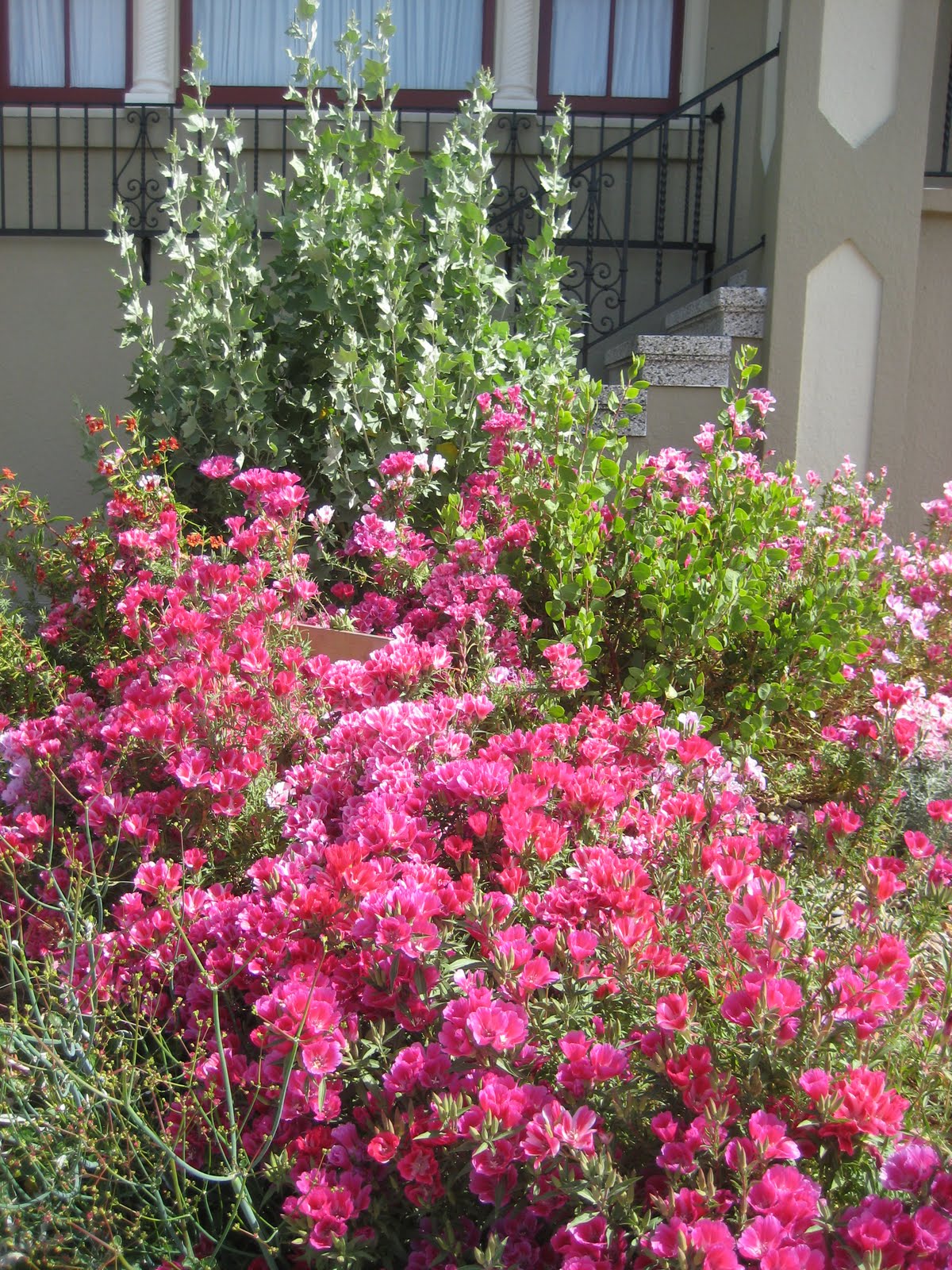
Around February, my garden came under attack from little sprouts of Clarkia amoena. Soon enough, a jungle of massive Clarkia plants created a new topography, towering over the Eriogonum grande rubescens, hiding the Dudleya hassei flowers and hey, wasn't there a Manzanita somewhere over there?
The almost neon flowers stun passersby, except the new populations of bees busily darting about with pollen crumbs smattered all over them! The flower color varies, but most commonly pink with magenta-brushed petals sets the stage. Salmon in the first photo and white with bursts of pink blush add variety.
Thankfully, Clarkia amoena is an annual, which means they'll grace us with their presence for late Spring, early Summer and then fade away. Besides using the fabulous dried seed heads in unusual floral arrangements, I had hoped that leaving them standing in the garden would also feed some local birds. Obviously they weren't interested, judging by the number of plants I now have. Oh well, more for me!
Many different Clarkias can be found throughout California and serve as a new wave of color after the Poppies and Lupines say their goodbyes for the season. The Pink Ribbons Clarkia can be especially festive!.
Sun: Full sun to part shade
Soil: I guess anything in between the extremes, but I've successfully had plants grow out of adobe-like clay
Plant: Sow seeds in the Autumn. It might be too late to find plants, but try Annie's. Put this one on your must-have list for next year!
Buy it: I'll gladly give seeds to anyone who wants them! I'll be up to my ears this year! Larner's also has some lovely Clarkia seeds of many different varieties.
Good for: Causing a riot in the garden! Filling in space when plants are young, continuing the show when the Poppies have faded, pink gardens, bee and butterfly gardens.
Thursday, June 10, 2010
Plant of the Week: Matilija Poppy
Here she is, the Queen of the garden! Besides having a Latin name that is easier to pronounce than her common one, Romneya coulteri reigns up to ten or twelve feet above her subjects. Her sumptuous flowers span an unthinkable 8 inches across at times and the crepe-like petals create a soft dream across the landscape. Never mind that she can be invasive in sandy, over-watered soils.... she's the Queen, she's conquering more territory!
It's flowers like this that make me imagine I'm a little Bumble Bee, shimmying my way through those tentacles of sunshiney pollen. As for the orgins of the name Matilija, I can't verify the myriad of Native American myths and legends found through the magic Google, but what seems to remain constant is that its orgins lie in the Chumash tribe.
Sun: Full sun to part shade
Soil: Infrequently watered clay seems best to keep her from pillaging other parts of the garden
Plant: In Autumn, Winter or early Spring before she flowers. Propagation can be challenging at best (click here for an adventurous lesson in that)
Buy it: Hmmm, all my usual suspects don't show it in stock. Bay Natives might have it and East Bay Wilds does have it. Yay! Bloom time and planting time don't usually go together, so perhaps try to wait until September or so if you can!
Good for: Slopes, cottage gardens, wild and unkempt gardens, making your neighbors totally jealous, stopping traffic, bee gardens, mixing with Agaves or Yucca whipplei for a contemporary pairing, the forgotten sunny corner in the yard.
Wednesday, May 26, 2010
Plant of the Week: Firecracker Flower
Pop! Boom! Oooooooohhh! That pretty much describes Brodiaea coccinea (or Dichelostemma ida-maia), a California native bulb. When planted in the Fall, this scarlet beauty will explode with flowers by Spring. It's native to the North Coast and prefers part shade/redwood type environments, although mine are hanging out in my South-facing Oakland garden with no signs of distress. Apparently, it was once considered a delicacy among Native Americans (although please don't try it at home until you've researched it...)
It looks like the blossom has petticoats!
Soil: well-drained to light clay (heavy clay can rot bulbs)
Plant: Unfortunately, no instant gratification for you! Nab some bulbs in the Fall for a show next Spring
Buy it: Scheeper's, Far West Bulb Farm, or Garden Natives might have it by next year, too.
Good for: a pop of red in Spring, pairing with gray-foliage or blue Fescues, honestly this one can be incorporated in any style of garden so just try it!
Even the upright dried flowers look interesting! Can't wait to see how it sets seed.
Friday, May 14, 2010
Plant of the Week: Bush Anemone
"A wooden cherry scent is faintly breathing the air" Tom Waits rasps in "Watch Her Disappear." A Carpenteria californica doesn't smell anywhere near cherry, but for some reason, this lyric comes to mind when I'm around it. It's not so much as a scent as it is a suggestion. The air seems cleaner, more pure with a softness that you can't put your finger on. The blooms turn this stately shrub into a confident bride, all white and lovely from Spring into Summer. Can you guess what my new favorite plant is?
Sun: Morning or filtered sun seems to be best, although near the Coast it can probably do sun
Soil: I'm getting mixed messages from my favorite research sites, so just try it and see what happens
Plant: Ideally in the Fall, but they're usually only available when they're about to bloom
Buy it: the wholesale nursery has them in 15 gallon containers (looking fabulous!) all the way down to 1 gallon. You can ask your local nursery to order one for you or try Las Pilitas or Yerba Buena
Good for: Contrasting with gray foliaged plants, English gardens, scented gardens, setting a flowery background to perennials (would look fabulous with Penstemon heterophyllus!), attracting pollinators
Friday, April 30, 2010
Plant of the Week: Lilac Verbena
Many plants I just don't get what all the fuss is about. Petunias. Huh? And those garish Verbenas! Yikes, too much. Well, enter Verbena lilacina 'De La Mina.' I decided to give her a chance in one of my latest gardens- dense clay soil, ravenous deer, furnace-like full sun against the house and lots of hungry bees. She didn't even flinch and bloomed so impressively right out of her one gallon container. Verbena lilacina brings the lace to the tea party- soft, feathery foliage and delicate lavender blossoms that carry on all year when planted near the coast. She was found on Cedros Island (Western coast of Baja) and introduced to the trade by the Santa Barbara Botanic Garden. Yay!
Sun: Full sun to part shade
Soil: Sandy to clay, but less water if planted in more clay soils
Plant: As soon as you can get your hands on it! Anytime should be fine. It's most often grown from cuttings.
Buy it: Many wholesale growers have it, so talk to your local nursery or ask Annie's, Yerba Buena, Bay Natives, or California Flora Nursery
Good for: Notorious plant killers wanting to reform their murderous ways and wanting to start out with something easy, attracting butterflies & other pollinators, year-round bloom, hot sun, deer-resistant gardens, native cottage garden borders
Thursday, April 22, 2010
Plant of the Week: Fuchsia Flowering Gooseberry
Let's face it- dangerous plants are pretty sexy. (at a distance, anyway) Take for instance, the Ribes speciosum or Fuchsia Flowering Gooseberry. Red spikes, bright green leaves, dangling fuchsia flowers that turn to glowing red berries in the Summer...
I'm in love as long as I have a pair of thick gloves on. Needless to say, it's best to position this beauty in a low traffic area or as a barrier. But stand back and let the hummingbirds take over as the blooms emerge in winter. Over time it will arch its way into a shrub and provide shelter to neighborhood birds, although I should say that it does go deciduous without summer water. I'm hoping that will be yet another show as the glossy berries hang off of the bare, thorny branches. Sounds dramatic!
Sun: According to my research, it's pretty adaptable.
Soil: Again, pretty darn adaptable. Well-drained is probably ideal.
Plant: Anytime. Could it be any easier to grow this?!
Buy it: Ask your local nursery to special order it, or talk to Las Pilitas Nursery, Yerba Buena Nursery, or California Flora Nursery
Good for: Directing traffic or as inexpensive burglar deterrents, habitat gardens, red gardens, shade gardens, but probably not for dim lit night-viewing gardens (ouch!)
Wednesday, April 7, 2010
Plant of the Week: Mariposa Lily
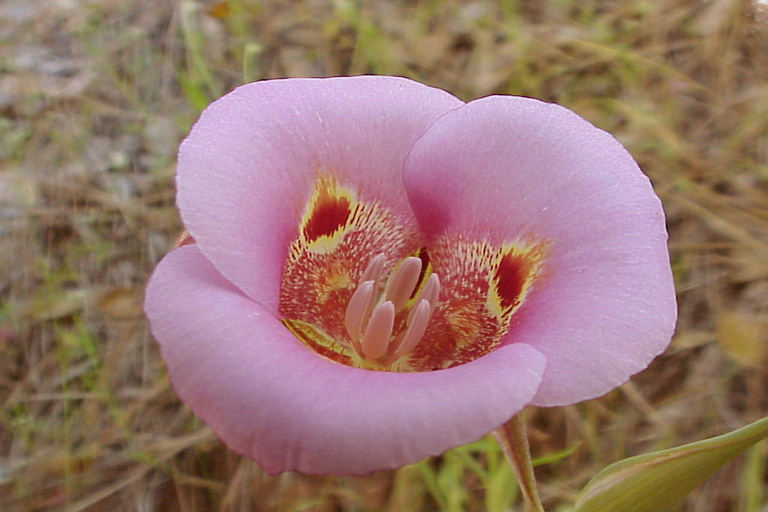
I'm getting tempted to gently pull apart the bud of this lovely Calochortus superbus just to see inside as my patience is that thin. Ok, I won't, but the suspense is terrible! It is with that anticipation that I preemptively name the Mariposa Lily "Plant of the Week."
A native bulb, Mariposa Lily emerges in the Spring, with lackluster foliage and a knock-out of a flower. Very Impressionist, I think! This is one of the natives that has found an international following. I obtained these bulbs from Scheepers, in Connecticut, of all places!
Photo found on Calphotos, © 2002 George W. Hartwell
Sun: Full sun to part shade
Soil: well drained with no summer watering
Plant: Stick the bulbs in the ground in Fall, but if there's greenery (a 4" or gallon container), try to plant it before it blooms
Buy it: Ok, next year I'm totally getting my bulbs from these guys, Far West Bulb Farm. They've got some fantastic varieties! If you didn't get a head start, Annie's might have some at the nursery.
Good for: Springtime showstopper, filling in blank spaces between new plantings, containers. I can't figure out if this flower supports wildlife. Mariposa means butterfly in Spanish, but is it because its petals resemble a butterfly's wings or because the butterflies enjoy its company? Anyone like to jump in here?
Friday, March 26, 2010
Plant of the Week: California Lilac
When you run into someone who says native plants all look half dead and boring, show them a Julia Phelps Ceanothus in full regalia. Oh yeah?! Take that! She's gorgeous! Plant a Ceanothus and you've extended an invitation to the native bee population. Have a picnic anytime, guys! Quail and other birds love the seeds and butterflies often drop in for a sip of nectar, too. The amazing thing about Ceanothus is its versatility. You can go for a tree-like specimen, a small shrub, even a low-growing ground cover. And as if that weren't enough, the variegated 'Diamond Heights' ground cover will stop people in their tracks.
Ceanothus have variable growing requirements (at least some varieties you can fudge more than others) so I'm generalizing here. Please refer to "California Native Plants for the Garden", Las Pilitas Nursery or your trusted plant guide for more detailed info.
Sun: Full sun to part shade. Some varieties work great under oaks
Soil: For the most part well-drained. It's best to pick one that's native to your general area. No beach-loving Ceanothus' in hardpan, please!
Plant: Preferably before some rain. Ceanothus don't like summer water. No, seriously... don't do it! If you plant before it rains, the storms will do the work for you without you having to worry about over watering. Mulch well and you're done!
Buy it: Ceanothus are so lovely that any nursery would be mad not to carry at least one variety! Click on the Las Pilitas link above to get the skinny on what's out there or just ask the nice folks at the nursery. Ignore them if they say they're short lived- they must have over-watered and made the Ceanothus angry.
Good for: a flowery focal point, habitat garden (that includes deer sometimes, so best to keep them out of harm's way for a few years), the neglected garden, cottage gardens, anyone who has the blues
Again, these are general descriptions, so check out the particular variety before paying attention to what I'm saying!
Thursday, March 11, 2010
Plant of the Week: Island Alum Root
Yes, I realize that I crowned Heuchera micrantha "Plant of the Week" mere months ago (at least I could have sworn I did, but can't find the post to link to it!), but when I arrived in this garden, it asked me so very politely to be included again with its dainty show of lace-like flower stalks. How could I refuse such a sweet request? I mean, look at her! A lovely addition to the shade garden and green all year 'round, Heuchera will delight a native cottage-style garden with no real fuss. I'm sure many of you have seen the hybridized Heucheras at local nurseries- same plant, only in shades of purples and bronzes. They'd be wonderful mixed in with this one, but my experience has told me that these native varieties give the best performance.
Sun: No! Shade or part shade will do nicely. Keep her away from scorchy afternoon sun.
Soil: The one shown above is in medium clay, I'd shy away from the sandier side of things
Plant: Buy them in 4" containers- they're usually the same size as the one gallons and will grow in pretty fast in the right conditions. Any time of year should be fine for starting out.
Buy it: At Annie's Annuals or Oaktown Native Nursery in Alameda. Also, try micrantha's cousin Heuchera maxima- another very lovely native that Las Pilitas graciously tells us all about (none in stock, however)
Good for: shade gardens, cottage style gardens, dreamy floral arrangements, wildlife gardens, deer-prone gardens
Thursday, March 4, 2010
Plant of the Week: Buttercups
Perhaps it's best to think of Ranunculus californicus as a healthy alternative to the mustard you see blooming in open fields. Mustard is lovely this time of year, but it has a tendency to run rampant and choke out most of everything else. Too much of a good thing, in my opinion. Buttercups, however wave little yellow fairy wands through the emerging grasses, a little here, a little there. Nothing says meadow better than a smattering of Buttercups! We found them on the road to Borges Ranch, a delightful farm to visit this time of year.
Soil: Believe it or not... Clay! Glorious clay!
Sun: Full sun to part shade
Plant: In the Fall, before it emerges from its Summer nap or now if you can't help yourself!
Buy it: Annie's Annuals, Oaktown Native Nursery in Alameda, or Native Here might have a few, but this note was what came up on their catalog page. I'm sure you'd come home with something!
Good for: Stubborn clay soils where you'd like a little meadow, wildlife gardens (the seeds are edible!), a mustard alternative, viewing far away and close up
Wednesday, February 24, 2010
Plant of the Week: Pink Chapparal Currant
Ribes malvaceum is the princess of the coming Spring reminding us that bare branches and brown clumps of plants will soon become a bounty of flowers buzzing with activity. She sleeps through late Summer and into Autumn, budding leaves as the rains arrive and sending these long pendulous flower clusters just after we've been surprised by the leaves' abrupt appearance. And then the flowers open. . . Sigh. Such a lovely flash of pink when all else can look so dreary this time of year. Ribes malvaceum (or its cousin, Ribes sanguineum) is available in a few varieties, ranging from White Icicle (sanguineum) to Barrie Coates (malvaceum), a deep crimson which I just spied at the nursery today and cursed the more prepared gardener who had put them all on hold. Darn! I love this pink version, however.
ack, overexposed photo!
Sun: partial shade to sun near the Bay (or coast), partial to full shade farther in.
Soil: I think you can stretch it a bit- Las Pilitas mentions planting a sanguineum in sand and another in clay with relative success. But they're pretty good at this stuff. I'd go with a good combo of the two and call it a day. Although, I won't tell if you fudge it a bit.
Plant: after the heat of Summer and before the rains in Winter is best.
Buy it: your local nursery can order it if you like, but Las Pilitas' Santa Margarita store has a few in stock or you could try California Flora Nursery, who looks like has a ton of yummy varieties to sample.
Good for: bird gardens, a bright bit of Spring for us impatient gardeners, shady places, cottage gardens
Thursday, February 18, 2010
Plant of the Week: Violets
Allow me to introduce you to my new favorite non-native (but edible!) plant. It was the scent, I'm telling you. As soon as I bumped my nose to the flower, I was hooked. It's an indescribably beautiful thing, like touching angora for the first time. Gentle, soft and completely pleasant. I immediately had it in my mind that I needed half a dozen and that I would candy them and throw a tea party in their honor. Or violet jellies! Oh crap, I'm getting too excited about this. This link talks about various things violets are used for. There are also native Violas, but I haven't done too much research on them.
I wish I could spend more time telling you all about the growing conditions and where to buy them, but I am in hummingbird mode this week with tons of planting. Please allow me to zoom away- I'll be hovering around more next week!
Labels:
idora design,
plant of the week,
viola odorata,
violets
Wednesday, January 27, 2010
Plant of the Week: Showy Milkweed
Photo from Wikipedia by author Vicki Watkins
With the rain sidelining my outdoor activities, the world wide web has been my garden outlet and I'm obsessing over Asclepias speciosa, or Showy Milkweed right now. Full disclosure is that I've tried this plant twice and both times it died in defiance of my wish for clouds of happy butterflies. I haven't lost faith- I'm planning on buying a few for the front garden and I'll report back on what happens.
Asclepias is a tuber that shrinks back after it blooms, but can leave fiberglass-like stalks that the birds like to use for nest-making (or at least that's what Las Pilitas says). When it blooms, a bevy of insects stampede the garden to enjoy its nectar. Monarch butterfly larvae gobble up the foliage, as the poisonous leaves that they ingest help protect them from predators. It's not unusual to find their turquoise and gold-dotted chrysalis' hanging from a stem.
Soil: Well-drained, but the key is no summer water. This plant can't be mixed with water loving exotics.
Sun: Full sun, although the photo above was taken at the base of a north-facing hill in the Trinity Alps.
Plant: When it's dormant, perhaps when the first rains start.
Buy it: Native Here Nursery carries a relative- Asclepias fascicularis, Annie's carries speciosa. The link above to Las Pilitas shows that they carry them at the nursery, but not for the online store. Hmmm.
Good for: a must for the habitat garden, deer resistant gardens, dry cottage gardens (so romantic paired with Lupines and white CA poppies!), gardeners that don't like to water
Labels:
asclepias,
butterfly plants,
idora design,
milkweed,
plant of the week
Wednesday, January 20, 2010
Plant of the Week: Silk Tassel
It's one thing to drool over a photo or poetic description of a new plant, but it's quite another to stop in your tracks and stare stupidly with your mouth hanging open. Between torrential downpours today, that's exactly what occurred between me and Garrya eliptica. Truth be told, I've walked past this friendly shrub too many times to count, yet it's not until it screamed for attention that I noticed the poor dear. Just look at these traffic stopping flowers! Now that I'm paying attention, I'm noticing how nice its crinkle-edged leaves have fuzzy white undersides characteristic of many of our native plants. Nice! Garrya happily grows near the coast in well-drained soil, providing an evergreen hedge or screen and then knocking you out in winter with these stunning blooms. Male plants produce longer catkins, with the variety 'James Roof' providing the best show.
Soil: well-drained
Sun: full to part sun
Plant: the Fall might be ideal, after the summer heat and before the flowers are expected to appear. The Spring would be good, as well.
Buy it: California Flora Nursery shows one in stock, the Native Here Nursery seems to carry them, too. For those on the Southern side of things, Las Pilitas Nursery will help you out.
Good for: creating an evergreen background (pair it with Manzanitas for a winter wonderland of flowers!), garden drama, floral displays, deer sensitive gardens
Tuesday, January 12, 2010
Plant of the Week: Hummingbird Sage
Salvia spathacea is the plant for those shady gardeners with sun denial. While Hummingbird Sage indeed goes home to the Sage family for the holidays, it uncommonly thrives in part sun/shade conditions while its brothers and sisters shake their heads and bask in the hottest of conditions.
While many of our native Salvia's foliage have a musky scent, Salvia spathacea exudes a sweet, pineapple frangrance to delight the senses. As the name suggests, when it's magenta flowers appear on twisting, curving flower stalks the Hummingbirds' chirp is never far off and buzzy fly-bys become frequent occurrences.
What I enjoy about this plant is that I can show it to people who think California natives are gray and scraggly. It would look equally at home under oak trees as it would in a white picket fenced cottage garden!
Soil: well-drained but medium clay
Sun: part sun to part shade. I find morning sun and afternoon shade works best.
Plant: Any time of year, really. They grow fast from 4" pots.
Buy it: Annie's is out of stock for mail order, but they may have some at the nursery. Yerba Buena has a few. Oddly enough, California Flora Nursery carries the 'Las Pilitas' variety while Las Pilitas Nursery carries a few different varieties, along with its signature one.
Good for: a shot of color when you're in a shady disposition (mix it with Douglas Iris!), cottage gardens, habitat gardens, culinary or sensory gardens, under water intolerant trees, or trailing out of a brightly colored container.
Wednesday, December 9, 2009
Plant of the Week: Western Clematis
While leaves are dropping and greenery becomes scarce this time of year, Clematis ligusticifolia keeps on truckin'. Sure, she's not dripping with lovely white flowers right now. Ok, so her octopus-like seed heads are getting a liitle rough around the edges. An evergreen vine refreshes the eyes after a yellow and brown overload.
The clematis vine at Larner Seeds had conquered a small fence and looked like it was ready for world domination. It's seed heads were worn like medals of courage, interspersed up and down its tendrils.
Soil: Clematis prefers cool roots, so mulch generously if she'll be in sun. Otherwise, well-drained to light clay should do nicely.
Sun: The one pictured at the top sits in mostly-shade. The one at Larner Seeds had part to full sun. Go figure.
Plant: Anytime! Be careful with transplanting, though. Vines typically have very sensitive roots that don't like the hustle and bustle of a transplant. (Bougainvillea are notorious for this kind of behavior, by the way)
Buy it: Annie's carries it and has a lovely photo of one in full bloom, Oaktown Natives seems to have one in stock, and if you're into the propagation thing, Larner's carries seeds.
Good for: Greenery when you're blue, gorgeous white flowers, space-age seedheads, a vine for shade and to scramble up trees, a trellis adornment.
Wednesday, December 2, 2009
Plant of the Week: Manzanita
I'm surprised when I discover that not every single person in this world likes Arctostaphylos. Some people even hate it, as I'm learning when I send my plant lists to clients. Now I'll be first to admit that there's some varieties that look a little too scrubby for my tastes, but on the other hand, there's ka-zillions to choose from.
The variety pictured above is 'St. Helena' and will eventually grow into a small tree. When I say eventually, I mean in close to forever. They grow real slow. But look how pretty she is! It's amazing what a little aesthetic pruning will do to accentuate the dramatic curves of the tree. Plus, the dark mahogany of the branches contrast so nicely with the blue-green leaves. White flowers appear in winter and will give the hummingbirds something to do when nectar is scarce. Flowers give way to berries, which will bring the birds. Isn't it nice how that all works out?
Soil: Light clay will do quite nicely. I've seen some varieties grow in absolute hardpan in the foothills.
Sun: Full, please!
Plant: Now, before the winter rains! Although I planted mine at the worst possible time, (beginning of summer) they seem pretty happy.
Buy it: The wholesalers seem to carry this variety (support your local nursery and ask them to order it for you), but there are so many to learn about, too! Yerba Buena Nursery carries this species and many more.
Good for: contrast in the garden, attracting wildlife, sculptural interest, winter flowers and spring berries
Subscribe to:
Posts (Atom)